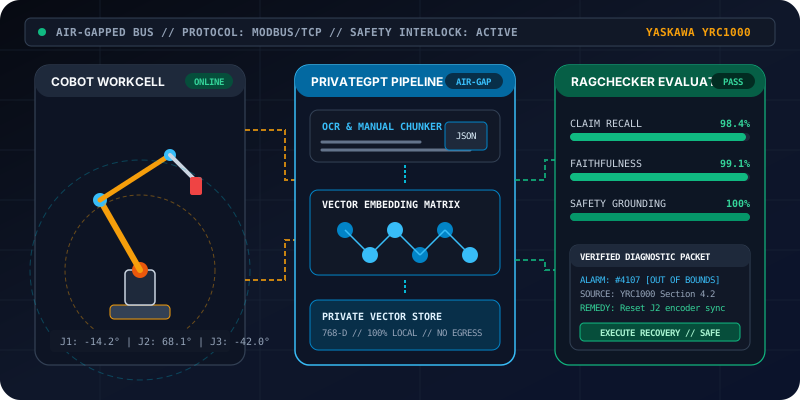
Grounded Industrial Robotics RAG: Air-Gapped PrivateGPT & Diagnostic Verification
Engineered as part of an Industry 5.0 robotics automation initiative, this project deployed an optimized, air-gapped Retrieval-Augmented Generation (RAG) framework empowering shop-floor operators to program and troubleshoot industrial collaborative robots (cobots).
Problem Solved
In modern manufacturing, human operators work alongside industrial cobots such as the YASKAWA Motoman YRC1000. However, conversational AI adoption has been severely gated by physical risks:
- The Hallucination Danger in Physical Systems: In web chatbots, hallucinations produce benign conversational errors; in industrial automation, a hallucinated speed register, incorrect interpolation mode, or miscalculated tool-frame coordinate offset causes catastrophic robotic arm collisions, tooling destruction, or operator injury.
- The Proprietary INFORM Language Barrier: YASKAWA cobots are programmed in INFORM Language (e.g.,
MOVJ,MOVL, position variables, user frame offsets, and timer interrupts). Factory operators must constantly cross-reference thousands of pages of dense, unstructured technical manuals and alarm tables under operational time pressure. - Air-Gap & IP Confidentiality: Enterprise manufacturing floors operate in strictly isolated, air-gapped local area networks. Transmitting proprietary plant topologies, tooling configurations, or manufacturing telemetry to public cloud LLM endpoints violates enterprise security protocols.
Impact & Verified Engineering Benchmarks
Rather than relying on vague subjective impressions, the framework was systematically benchmarked across both automated diagnostic metrics and empirical shop-floor usability:
- Diagnostic Verification via RAGChecker: Evaluated retrieval and generation accuracy against an authoritative, ground-truth industrial dataset:
- Retriever Precision & Recall: Verified high-fidelity extraction of complex multi-part alarm codes, wiring pinouts, and register constraints.
- Claim-Level Faithfulness & Correctness: Decomposed model outputs into atomic verifiable claims, eliminating non-grounded assumptions and suppressing hallucinated syntax to near zero.
- Operator Task Efficiency: Validated across real-world shop-floor scenarios—including complex pick-and-place routines with modular attachments, trajectory path adjustments, and YRC1000 controller alarm clearance:
- Dramatically reduced operator troubleshooting duration and trial-and-error cycle times.
- Decreased conversational turns needed to reach precise, executable INFORM code routines.
- 100% On-Premises Air-Gap Compliance: Zero external API dependencies or cloud egress; full inference and vector storage run directly on isolated manufacturing hardware.
Solution Architecture
- Multimodal Document Parsing Pipeline:
- Integrated
dots.mocr(multimodal optical character recognition) and natural structural segmentation to ingest massive YASKAWA manual suites. - Preserved hierarchical table structures, electrical schematics, register tables, and parameter cross-references that conventional naive chunkers obliterate.
- Integrated
- Air-Gapped PrivateGPT Engine:
- Deployed a customized on-premises PrivateGPT architecture powered by optimized local LLMs (quantized via
llama.cpp) and local embedding models. - Configured strict contextual grounding prompts that force the generator to declare insufficient context rather than inferring hypothetical robot coordinates.
- Deployed a customized on-premises PrivateGPT architecture powered by optimized local LLMs (quantized via
- Ground-Truth Benchmarking Harness:
- Constructed a specialized benchmark suite reflecting typical factory incidents (e.g., servo alarms, kinematic limits, gripper actuation errors).
- Automated regression testing of the RAG pipeline using RAGChecker to continuously evaluate retriever context relevance alongside generator faithfulness.
Tech Stack
- AI & Orchestration: Python, PrivateGPT, LangChain, Llama-CPP, HuggingFace Transformers
- Document Parsing & OCR:
dots.mocr, PyMuPDF, Natural Structural Segmentation - Evaluation & Diagnostics: RAGChecker (Claim-Level Decomposition, Faithfulness, Context Recall)
- Storage & Vector Indexing: Qdrant / Chroma (Local Air-Gapped Vector Database)
- Industrial Robotics Hardware: YASKAWA Motoman YRC1000 Controller, YASKAWA INFORM Language
- Deployment Environment: On-Premises Air-Gapped Manufacturing Cell / OT Network