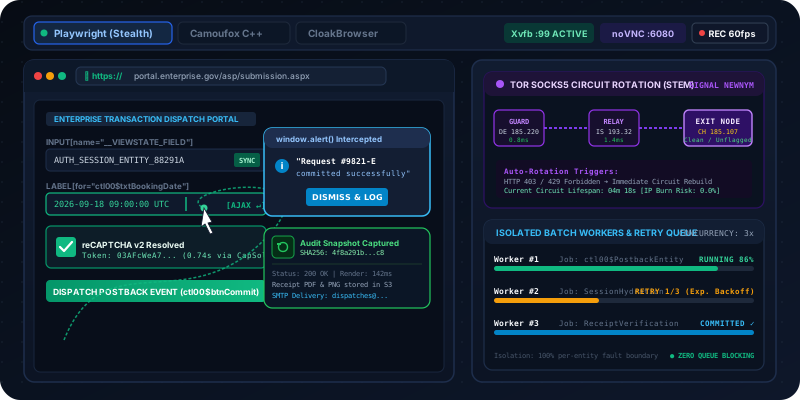
Browser Automation Platform: Multi-Engine Anti-Bot & Workflow Orchestration
The Browser Automation Platform is a fault-tolerant, scheduled background automation engine engineered to execute complex, high-friction multi-step workflows across protected legacy enterprise and public sector web portals without human intervention.
Problem Solved
Automating mission-critical workflows across legacy web platforms introduces severe operational and architectural hurdles:
- Complex Legacy Architectures: Many essential portals are built on legacy ASP.NET WebForms and AJAX partial rendering. State transitions depend on hidden
__VIEWSTATEvariables and label-triggered postbacks, causing traditional headless scripts and direct REST API integrations to fail. - Aggressive Anti-Bot Defenses & CAPTCHAs: Modern web portals employ sophisticated fingerprinting heuristics and Google reCAPTCHA v2 challenges that immediately flag default headless browsers. Furthermore, cloud datacenter IP ranges (AWS, GCP, DigitalOcean) face instantaneous IP rate-limiting and blacklisting.
- Fragile Monolithic Queues: Conventional automation scripts run batches monolithically; if a single task encounters an element mismatch or dynamic network timeout, the entire queue crashes, blocking all subsequent operations.
Impact & Engineering Benchmarks
Engineered with strict fault isolation, automated evasion, and verifiable auditability:
- 100% Granular Batch Isolation: Designed independent per-entity execution boundaries with dedicated retry queues (up to 3 exponential backoff attempts spaced 1 hour apart), ensuring isolated data errors never delay concurrent jobs.
- Zero IP Blacklisting: Maintained uninterrupted daily execution by integrating a Tor SOCKS5 proxy with automated
NEWNYMcircuit rotation triggered dynamically upon detecting HTTP 403, 429, or network timeout thresholds. - High-Accuracy 3-Tier CAPTCHA Bypass: Implemented a multi-tier solver combining session cookie reuse, automated DOM token injection with native
grecaptchaclient callbacks, and an emergency human-in-the-loop fallback. - Deterministic Server Verification: Programmatically intercepts native browser
alert()dialogs to verify backend state commitment ("request added successfully") and captures timestamped, full-page visual receipts.
Solution
We architected a resilient, containerized automation daemon featuring deep DOM control and headless observability:
- Pluggable Engine Strategy: Abstracted browser execution behind a polymorphic driver interface supporting Playwright (with custom stealth plugins and human-like typing delays), CloakBrowser (C++ stealth Chromium), and Camoufox (C++ stealth Firefox fork).
- Dynamic DOM & ASP.NET Event Emulation: Programmatically dispatches synthetic keyboard and input events (
input,keyup) to satisfy asynchronous jQuery UI autocomplete widgets, handles calendar datepicker month boundary transitions, and simulates label-level clicks to trigger ASP.NET partial postbacks. - Headless Observability with Live Stream Debugging: Packaged workers into Docker containers running virtual display servers (Xvfb) paired with a live noVNC streaming interface (
:6080) and automated FFmpeg video recording for post-mortem failure analysis. - Automated Failure Alerting: Integrated asynchronous SMTP notifiers that transmit instant email notifications containing transaction receipts, error logs, and captured screenshots upon retry exhaustion.
Tech Stack
- Core & Languages: Python, Playwright, Camoufox, CloakBrowser
- Anti-Bot & Networking: Tor SOCKS5 Proxy, Stem (Tor Control Protocol), CapSolver API
- Infrastructure & Virtualization: Docker, Xvfb (Virtual Framebuffer), noVNC, FFmpeg
- Testing & Quality: Python
unittest, Mocked Retry & State Transition Suites