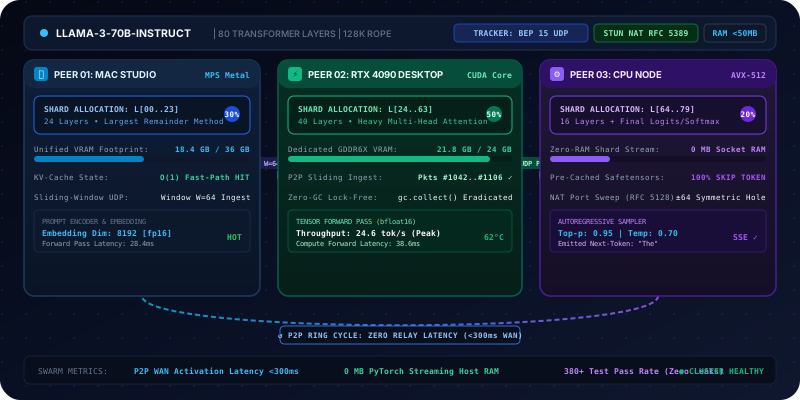
SwarmInfer: Decentralized Heterogeneous Swarm LLM Inference Engine
SwarmInfer is a decentralized, heterogeneous swarm inference engine designed to run frontier Large Language Models (14B, 32B, 70B+) by aggregating the memory and compute of everyday consumer hardware across the internet without requiring VPNs, port forwarding, or centralized relay servers.
Problem Solved
Serving modern frontier open-weight models introduces steep infrastructural and financial barriers:
- The VRAM & Hardware Wall: Running 32B to 70B+ models demands 32GB to 160GB+ of VRAM, pricing developers out with $5,000–$20,000 workstation requirements or expensive cloud GPU subscriptions.
- Untapped Consumer Hardware: Many developers own capable machines—such as an Apple Silicon Mac (Metal MPS), a gaming PC with an NVIDIA RTX GPU (CUDA), and multi-core work laptops—with no seamless mechanism to pool their collective VRAM and compute power.
- Datacenter Assumptions in Existing Frameworks: Frameworks like vLLM, DeepSpeed, and Ray assume high-speed, flat datacenter networks (InfiniBand/RoCE, homogeneous GPUs, direct IP routing). They fail immediately across consumer Wi-Fi, cellular 5G hotspots, and asymmetric network conditions.
Impact & Engineering Benchmarks
Rather than theoretical figures, SwarmInfer was engineered with verified systems-level benchmarks:
- Zero-RAM Disk Shard Streaming: Pre-sliced
.safetensorsstream chunk-by-chunk directly from disk over network sockets—guaranteeing 0 MB PyTorch tensor RAM allocation on streaming hosts. - Ultra-Low Coordinator Footprint: The master coordinator requires $<50\text{ MB}$ of RAM, utilizing lazy layer materialization only after topology partitioning is resolved.
- Sub-300ms WAN Activation Transport: Custom pipelined sliding-window UDP ($W=64$) streams activation tensors across cellular 5G hotspots with in-order sequence reassembly.
- Zero-GC Latency Elimination: Eradicated all
gc.collect()calls during forward passes and introduced an $O(1)$ fast path inensure_shards_loaded(), guaranteeing stable tensor residency and zero latency spikes. - NAT Traversal Without VPNs: Combined RFC 5389 STUN and RFC 5128 Port-Window Sweeping ($\pm 64$ ports) to punch through symmetric and cone NATs without port forwarding or Tailscale.
- Adversarial Verification: Validated across 380+ tests in 30+ test modules, including empirical stress suites verifying adversarial packet corruption, simulated packet drops, multi-process race conditions, and zero resource leaks (
-W error::ResourceWarning).
Solution
SwarmInfer splits Transformer execution into a resilient, decentralized peer-to-peer pipeline:
- Heterogeneous Fractional Sharding: Partitions Transformer layers dynamically using the Largest Remainder Method across asymmetric hardware (Metal MPS on macOS, NVIDIA CUDA on Linux/Windows, and multi-core CPU) proportional to available device memory and compute.
- Decentralized Rendezvous & Topology: Coordinates discovery via BitTorrent BEP 15 UDP Trackers (Magnet hashes) for global peer rendezvous without centralized servers. Includes 60s join grace periods, 30s heartbeats, and auto-healing topology rebalancing.
- P2P Ring Forwarding: Directly streams activation tensors between peers ($Node_1 \to Node_2 \to Node_3$) to maximize network bandwidth, with automatic fallback to star topology if an intermediate peer disconnects.
- 100% Cache Bypass: Workers with pre-cached layer files transmit
SKIPtokens and initialize directly from local storage, eliminating redundant network transfers on cluster restart. - Robust Daemon Lifecycle: Built a comprehensive CLI (
serve,join,generate,status,firewall,stun) with atomic cluster state persistence (active_cluster.json) and clean SIGINT/SIGTERM process handling.
Tech Stack
- Compute & ML: Python, PyTorch, Apple Metal (MPS), NVIDIA CUDA, HuggingFace Transformers, Safetensors
- Networking & Protocols: Custom Sliding-Window UDP ($W=64$), RFC 5389 STUN, RFC 5128, BitTorrent BEP 15 UDP Trackers
- Architecture: Asynchronous I/O (
asyncio), P2P Ring Pipelining, Fractional Sharding (Largest Remainder) - Quality & Testing: Python
unittest, Stress/Adversarial Network Testing Suites, Zero Resource Leak Enforcement